

Blog
Understanding Ohio’s Electric Bicycle Classes

Common E-Bike Myths: Fact vs. Fiction
❌ Myth: I need a driver’s license to ride an e-bike.
✅ Fact: Ohio’s Class 1, Class 2, and Class 3 electric bicycles are not treated as motor vehicles. No driver’s license is required to operate a qualifying e-bike.
❌ Myth: My e-bike needs a license plate and registration.
✅ Fact: Electric bicycles meeting Ohio’s statutory definition do not require registration, license plates, or vehicle insurance.
❌ Myth: A Class 2 e-bike is basically a motorcycle.
✅ Fact: Class 2 e-bikes are still bicycles under Ohio law. The primary difference is that they may provide motor assistance through a throttle without requiring the rider to pedal. The motor is not capable of providing assistance once the bicycle reaches 20 MPH.
❌ Myth: I can ignore traffic laws because I’m on a bicycle.
✅ Fact: E-bike riders generally have the same rights and responsibilities as traditional bicyclists. Riders must obey traffic signs, signals, and other applicable laws.
❌ Myth: Faster is always better.
✅ Fact: Riders should always travel at a speed that is reasonable and prudent for conditions. Shared-use paths, crowded areas, poor weather, and reduced visibility may require speeds well below the bicycle’s maximum assisted speed.
❌ Myth: Helmets aren’t important on e-bikes.
✅ Fact: E-bikes can travel significantly faster than traditional bicycles. While helmets may not be required in every situation, they are strongly recommended for riders of all ages. Ohio law requires helmets for operators and passengers under 18 years of age riding Class 3 electric bicycles.
❌ Myth: I can ride my e-bike anywhere I want.
✅ Fact: While e-bikes are generally permitted on roads, bike lanes, and many shared-use paths, local governments, park districts, and property owners may impose additional restrictions. Always observe posted signs and regulations.
❌ Myth: Electric bicycles don’t need maintenance.
✅ Fact: Brakes, tires, lights, chains, batteries, and electrical systems should be inspected regularly. Proper maintenance helps ensure safe operation and reliable performance.
Understanding Ohio’s Electric Bicycle Classes
As electric bicycles (e-bikes) continue to grow in popularity, the Hebron Police Department wants to help riders understand the different classifications established by Ohio law and how they are intended to be operated safely on our roadways and shared-use paths.
Ohio law recognizes three classes of electric bicycles. While each class offers unique features, all e-bike riders share the responsibility of operating safely and courteously around other motorists, bicyclists, and pedestrians.
What Is an Electric Bicycle?
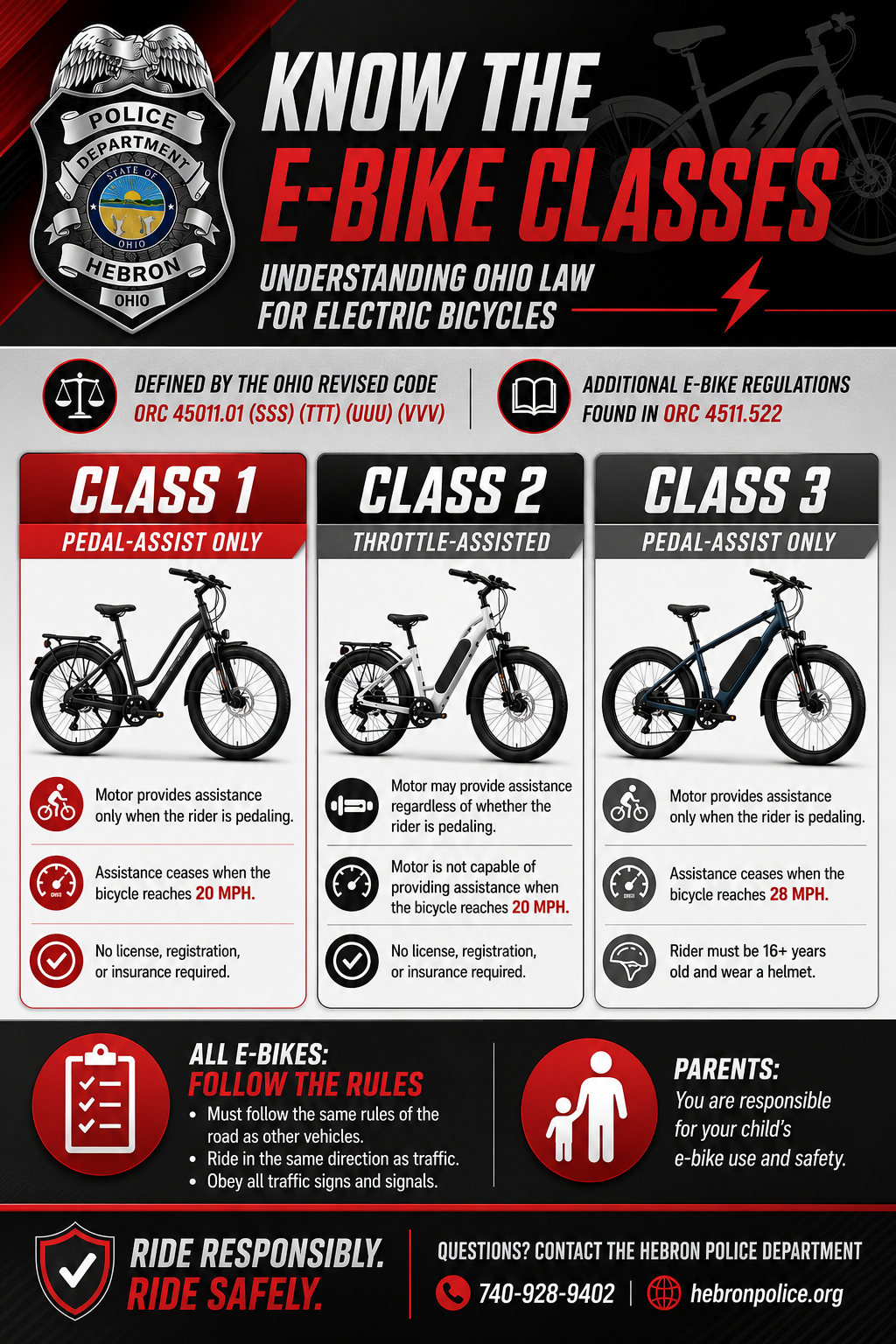
Under Ohio Revised Code §4511.01(SSS), an electric bicycle is defined as either a Class 1, Class 2, or Class 3 electric bicycle. All classes must be equipped with fully operable pedals and an electric motor producing less than 750 watts of power.
Class 1 Electric Bicycle
A Class 1 electric bicycle provides motor assistance only while the rider is pedaling. The motor stops providing assistance when the bicycle reaches 20 miles per hour.
Key Characteristics:
- Pedal-assist only
- No throttle
- Maximum assisted speed of 20 MPH
- Electric motor less than 750 watts
Class 1 e-bikes are often considered the most similar to traditional bicycles because riders must actively pedal to receive assistance.
Class 2 Electric Bicycle
A Class 2 electric bicycle may provide motor assistance regardless of whether the rider is pedaling. These bicycles are commonly equipped with a throttle that allows the rider to engage the motor without pedaling.
The motor is not capable of providing assistance once the bicycle reaches 20 miles per hour.
Key Characteristics:
- May include a throttle
- Pedaling is not required for motor assistance
- Maximum assisted speed of 20 MPH
- Electric motor less than 750 watts
Because riders can accelerate without pedaling, Class 2 e-bikes require extra awareness around pedestrians and in congested areas.
Class 3 Electric Bicycle
A Class 3 electric bicycle provides motor assistance only while the rider is pedaling, similar to a Class 1 bicycle. However, the motor may continue providing assistance until the bicycle reaches 28 miles per hour.
Key Characteristics:
- Pedal-assist only
- No throttle
- Maximum assisted speed of 28 MPH
- Electric motor less than 750 watts
Due to their higher assisted speeds, Class 3 e-bikes are best suited for riders who travel longer distances or commute on roadways.
Rules of the Road
Ohio Revised Code §4511.522 establishes additional regulations regarding the operation of electric bicycles. Regardless of class, e-bike riders should remember:
- Obey all traffic control devices and signals.
- Ride in the same direction as traffic.
- Yield to pedestrians when required.
- Use caution on shared-use paths and trails.
- Maintain a safe speed based on roadway, traffic, and environmental conditions.
- Ensure the bicycle is properly equipped and maintained.
Riders should also be aware that local jurisdictions may establish additional rules regarding where certain classes of e-bikes may be operated.
Safety Tips for Riders
Whether you’re riding a Class 1, Class 2, or Class 3 e-bike, safety should always be your top priority.
Before You Ride:
- Inspect your brakes, tires, and lights.
- Charge batteries according to manufacturer recommendations.
- Wear bright or reflective clothing when riding near traffic.
While Riding:
- Wear a properly fitted helmet.
- Remain alert and avoid distractions.
- Signal turns and lane changes.
- Watch for pedestrians, pets, and vehicles entering your path.
- Adjust your speed for conditions and visibility.
For Parents:
Parents should familiarize themselves with the capabilities of their child’s e-bike before allowing it to be operated. Understanding the differences between Class 1, Class 2, and Class 3 bicycles can help ensure riders use equipment appropriate for their age, experience, and riding environment.
Ride Responsibly. Ride Safely.
Electric bicycles offer a convenient and enjoyable way to travel throughout our community. By understanding the different classifications and following Ohio’s traffic laws, riders can help ensure that everyone enjoys a safe experience on our streets and pathways.
For questions regarding bicycle and traffic safety, please contact the Hebron Police Department at 740-928-9402 or visit HebronPolice.org.
References:
- Ohio Revised Code §4511.01 (SSS), (TTT), (UUU), and (VVV)
- Ohio Revised Code §4511.522